Depending on the methods used, a complimentary water test may provide screening information about total dissolved solids (TDS), the amount of chlorine or other disinfectant remaining in the water, when those characteristics are actually measured. It cannot establish overall water safety unless the relevant substances are tested using appropriate analytical methods. A single TDS reading does not tell you whether Sarasota tap water is safe. TDS estimates the combined amount of dissolved material in water; it does not identify each substance or distinguish a harmless mineral from a contaminant.
Before buying equipment, ask what was tested, how it was measured, and whether the comparison value is a health-based standard, an aesthetic guideline or a seller's preferred target.
What is TDS in drinking water?
Total dissolved solids, or TDS, is the combined concentration of dissolved inorganic salts and small amounts of organic matter in water. Calcium, magnesium, sodium, chloride and other dissolved substances can all contribute to the number.
A handheld TDS meter usually estimates TDS from electrical conductivity by applying a conversion factor. Temperature, calibration and the mixture of dissolved ions can affect that estimate, so the displayed number should not be treated as a laboratory analysis. Results are commonly displayed in parts per million; for dilute water samples, ppm is often treated as approximately equivalent to milligrams per liter.
For example, two water samples could show the same TDS value while containing very different mixtures of minerals and salts. That is why TDS is useful as a screening measurement, not a complete water-safety test.
Does a high TDS reading mean Sarasota water is unsafe?
No. TDS alone cannot establish that water is unsafe. The U.S. Environmental Protection Agency lists 500 mg/L as the secondary maximum contaminant level for TDS. Secondary standards address aesthetic or nuisance effects such as taste, deposits, staining and color; they are not health-based pass/fail limits.
A Sarasota mailing address may receive water from the City of Sarasota Utilities, Sarasota County Public Utilities, another public water system, or a private well. Identify the provider shown on your water bill and consult that provider's current Consumer Confidence Report. Do not apply one utility's water-quality results to customers of a different system.
Private wells require a different approach because the homeowner is responsible for testing the source. A well-water decision should never be based on TDS alone.
Why do free water tests sometimes lead to a sales appointment?
Some complimentary tests are legitimate demonstrations offered by businesses that sell treatment equipment. The test may be free because it begins a sales process.
That does not automatically make the test inaccurate, but the homeowner should separate three questions:
- What did the test actually measure?
- Does the result indicate a health concern, an aesthetic issue or ordinary mineral content?
- Is the recommended equipment designed to correct that specific issue?
Be cautious when a salesperson treats an "ideal" TDS target as a legal safety limit, will not provide results in writing, or recommends an expensive system without asking whether the home uses City water, County water or a private well.
What should a meaningful Sarasota water assessment include?
The right assessment depends on the complaint.
- White scale on fixtures: Test hardness and inspect the plumbing and water-using appliances.
- Chlorine taste or odor: Identify the disinfectant used by the serving utility and evaluate appropriate carbon filtration.
- Rotten-egg odor: Determine whether the odor occurs in hot water, cold water or both before blaming the municipal supply.
- Staining or discoloration: Test for the substances suggested by the color and source, especially on a private well.
- Health or contamination concern: Use a certified drinking-water laboratory and make sure it is certified to test for the specific substances you're concerned about. Select tests appropriate to the suspected problem; no single panel tests for every possible contaminant.
A plumber can diagnose treatment equipment, pressure, piping and fixture effects, but a field demonstration is not a substitute for appropriate certified laboratory analysis when health or contamination is the concern.
TDS meter, hardness test and laboratory test: what is the difference?
Comparison of TDS meters, hardness tests, disinfectant tests and certified laboratory analysis
| Test | What it helps answer | What it cannot answer alone |
|---|---|---|
| TDS meter | An estimate of the overall amount of dissolved material in the water | Which substances are present or whether the water is safe |
| Hardness test | How much calcium and magnesium hardness is present | Whether chlorine, bacteria or other contaminants are present |
| Disinfectant test | The disinfectant residual at that moment | Overall water composition or pipe condition |
| Certified laboratory panel | The concentration of specifically selected substances | Every possible water problem unless it was included in the panel |
Should you buy a filter, softener or reverse-osmosis system?
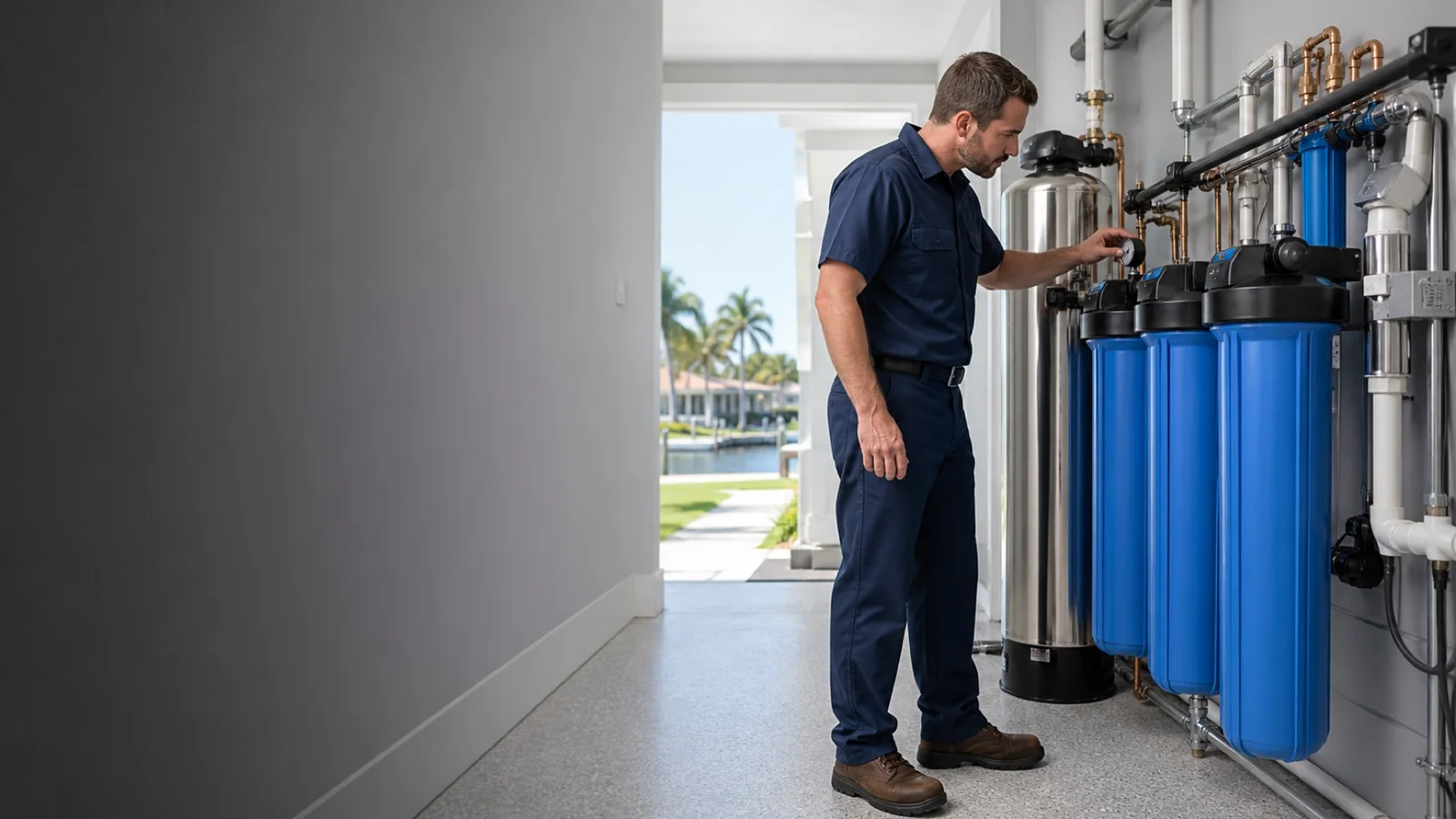
A conventional ion-exchange water softener addresses hardness by exchanging calcium and magnesium ions, commonly for sodium or potassium ions. It generally does not substantially reduce total dissolved solids. A whole-house carbon filter can reduce certain tastes, odors and disinfectant residuals when properly selected and maintained, but it does not substantially lower TDS because dissolved minerals pass through it. Reverse osmosis is designed to reduce many dissolved substances, although its performance depends on the membrane, water conditions and maintenance. No system removes every contaminant.
One system does not automatically replace the others. The correct configuration depends on the source-water results, household goals, plumbing layout, flow requirements and maintenance commitment.
For an overview, read our guide to whole-house water filtration in Sarasota and Manatee Counties.
Questions to ask before signing a water-treatment contract
- Can I receive the complete test results in writing?
- Which measurements came from calibrated equipment?
- Which recommendation corresponds to each result?
- Is the stated threshold an enforceable health standard, a secondary guideline or a manufacturer target?
- What are the equipment's flow rate and pressure-loss specifications?
- What filters, salt, media, membranes or service visits will it require each year?
- What happens to the warranty if maintenance is missed?
- Is plumbing installation, permitting and disposal of old equipment included?
Pro-Plumbing Works provides whole-house water filtration and softener service throughout Sarasota and Manatee Counties. For a plumbing-focused assessment and a free estimate, call 941-894-1127 or request service online.
Frequently asked questions
Is 250 ppm TDS bad for drinking water?
Not by itself. A value of 250 ppm indicates dissolved material is present, but it does not identify that material or determine safety. Compare specific laboratory results, not only TDS, with applicable drinking-water standards.
Is zero-TDS water always better?
No. Zero or near-zero TDS is not automatically necessary for household drinking water. Treatment should target verified concerns and account for taste, plumbing compatibility, wastewater and maintenance.
Can a plumber test water for contaminants?
A plumber can perform useful field screening and diagnose plumbing or treatment equipment conditions. When the concern involves health or contamination, use a certified drinking-water laboratory that can test for the specific substances you're concerned about.
Does Sarasota have hard water?
Hardness varies by water source and service area. Check the current report for the utility serving the address or test a private well. Visible scale is a clue, but a hardness test provides the useful measurement.
Will a whole-house filter lower TDS?
Many whole-house carbon filters do not substantially lower TDS because dissolved minerals pass through them. Conventional ion-exchange softeners also generally do not reduce TDS; they exchange hardness ions for other ions. Reverse osmosis is designed to reduce many dissolved substances, although its performance depends on the membrane, water conditions and maintenance.