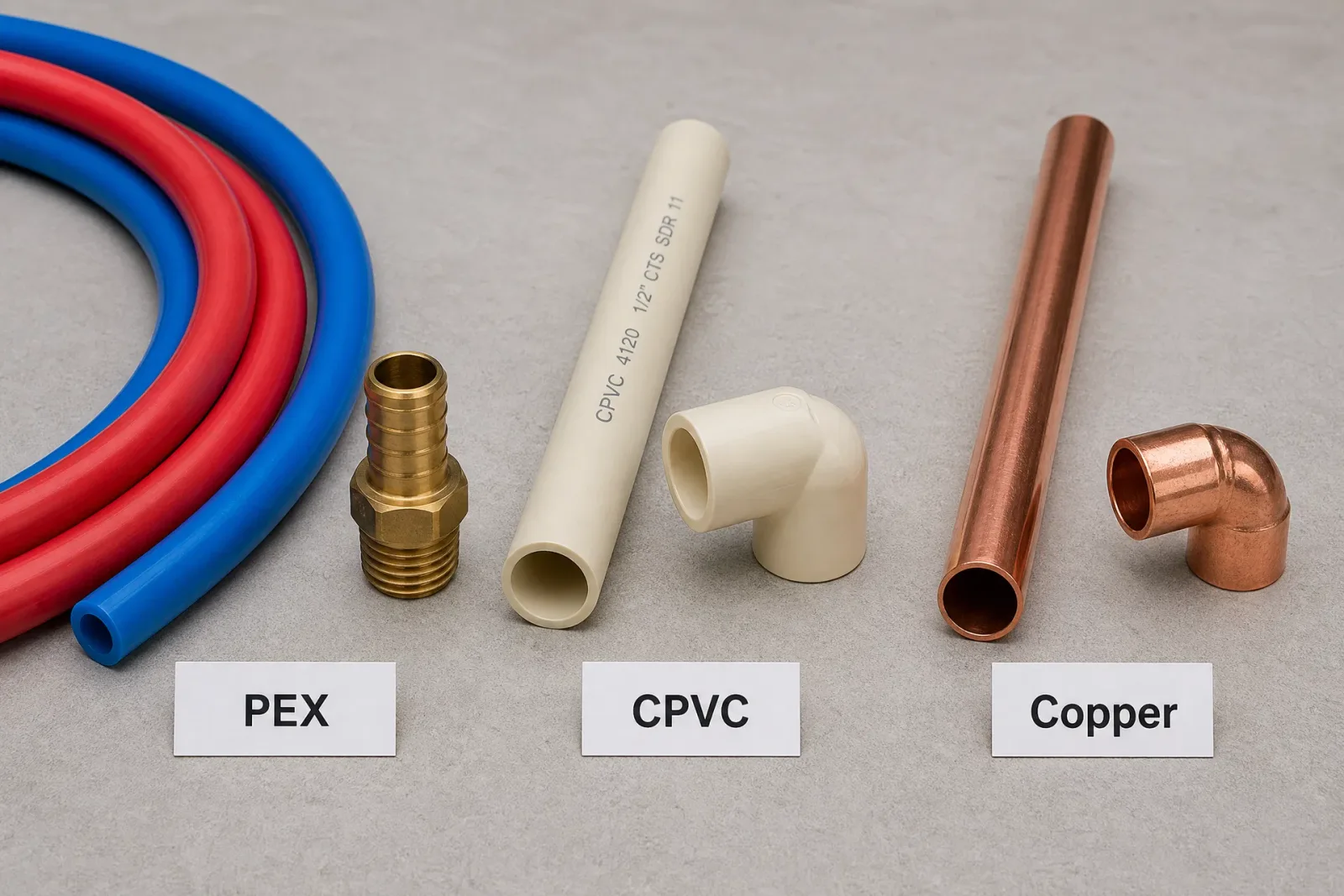
There is no single best repiping material for every Florida home. PEX is flexible and can reduce the number of fittings in many routes. CPVC is rigid plastic joined with compatible fittings and solvent cement. Copper is rigid metal with a long service history but typically costs more to install. The correct choice depends on code, location, sunlight exposure, water conditions, layout, budget and the installer's approved system.
For Sarasota homeowners, installation quality and a clearly defined scope matter at least as much as the material name.
What is PEX plumbing?
PEX is flexible cross-linked polyethylene tubing used for hot- and cold-water distribution. Its flexibility allows long runs around many obstacles and can reduce directional fittings compared with rigid pipe.
Potential advantages include:
- flexible routing through walls and attics;
- fewer fittings on some layouts;
- resistance to ordinary corrosion associated with metal pipe;
- relatively fast installation;
- manifold and trunk-and-branch design options.
Important considerations include:
- manufacturer-specific fittings and tools;
- protection from ultraviolet light;
- support, bend-radius and heat-clearance requirements;
- physical protection where tubing could be damaged;
- product-specific water-quality and temperature limitations.
"PEX" is not one interchangeable system. Ask whether the proposal uses PEX-A, PEX-B or another listed product and which fitting method will be installed.
What is CPVC plumbing?
CPVC is rigid chlorinated polyvinyl chloride pipe designed for hot- and cold-water distribution when installed in approved applications. Sections are joined with compatible fittings and solvent cement. The solvent cement, fittings, preparation and cure time must comply with the exact manufacturer's instructions and applicable code.
Potential advantages include:
- familiar rigid-pipe layout;
- broad availability;
- no metal corrosion;
- established installation standards.
Important considerations include:
- more joints and directional fittings than many flexible PEX routes;
- correct cure time and compatible solvent cement;
- support and expansion requirements;
- protection from impact and ultraviolet exposure;
- careful work around older installed pipe that may have become less forgiving.
Avoid assuming that every CPVC product, age or installation behaves the same. The manufacturer, pipe condition and workmanship matter.
What is copper plumbing?
Copper is a rigid metal piping material joined by soldering, press fittings or other approved methods. It has a long history in residential water distribution and remains attractive to homeowners who prefer metal piping.
Potential advantages include:
- long-established material and installation practices;
- dimensional stability;
- resistance to ultraviolet light compared with plastic tubing;
- multiple joining methods for qualified installers.
Important considerations include:
- usually higher material and labor costs;
- more fittings than a flexible-tubing route;
- susceptibility to damage when water chemistry, velocity, installation or electrical conditions are unfavorable;
- the need to choose the appropriate tube type and joining system.
Copper is not automatically permanent, just as plastic is not automatically inferior. The system must suit the house.
How do the materials compare?
| Factor | PEX | CPVC | Copper |
|---|---|---|---|
| Form | Flexible tubing | Rigid plastic pipe | Rigid metal tube |
| Typical route | Long bends and fewer fittings may be possible | Straight sections with fittings | Straight sections with fittings |
| Sunlight | Must follow strict UV limitations | Requires manufacturer-approved protection | More UV tolerant, though exterior installation still needs proper design |
| Joining | Expansion, crimp or other listed systems | Solvent-cemented fittings and joints | Soldered, pressed or listed mechanical fittings |
| Corrosion | Does not corrode like metal | Does not corrode like metal | Can be affected by water and installation conditions |
| Cost | Often lower than copper | Often cost-competitive | Commonly higher |
This table is a planning comparison, not a design specification. Local code, product listings and manufacturer instructions control the installation.
Can PEX or CPVC be installed outside in Florida?
Do not assume indoor plastic piping can be exposed to Florida sunlight. UV exposure can damage or shorten the allowable exposure of many plastic pipe products. Paint or improvised wrapping is not automatically an approved solution.
Exterior routing must use a material and protection method approved for that location. Ask the contractor to identify the manufacturer's exposure requirements and how the installation will be shielded from sunlight, heat, impact and weather.
Is one material better for Sarasota's water?
The answer depends on the actual water source and conditions at the property. Sarasota-area homes may use City water, County water, another utility or a private well. Pressure, disinfectant, pH, hardness and temperature can differ.
A responsible recommendation should consider:
- current pipe failure pattern;
- static and flowing pressure;
- water source and treatment;
- hot-water temperature;
- indoor, attic and exterior routes;
- grounding and bonding considerations for existing metal systems;
- manufacturer warranty requirements.
Because treatment and source water can influence a repipe decision, review our existing guide to whole-house water filtration in Sarasota and Manatee Counties before assuming that new pipe alone will correct a water-quality complaint.
Why does installation quality matter so much?
Every system can fail when it is poorly installed. Common preventable risks include unsupported pipe, excessive stress at fittings, incompatible components, improper solvent work, poor crimp or expansion connections, unprotected penetrations and unsuitable exterior exposure.
Ask who will perform the work, how it will be tested, what permits apply and whether the contractor will use one complete listed system rather than mixed components.
Questions to ask a repiping contractor
- Which exact pipe and fitting system are you proposing?
- Why does it fit this home's water source and routing?
- Will any piping be exposed to sunlight or extreme attic temperatures?
- How many fixtures and exterior hose connections are included?
- What old piping will remain?
- How will the system be pressure-tested?
- Who handles permits, inspection and wall repair?
- What product and workmanship warranties apply?
- Will shutoff valves and appliance connections be replaced?
- If existing metal water piping contributes to the home's electrical grounding or bonding, who will coordinate an evaluation by a qualified electrician before that piping is removed or replaced?
The bottom line
PEX emphasizes flexible routing, CPVC offers a rigid plastic system, and copper provides a traditional metal option. Choose based on a licensed contractor's documented recommendation, a complete listed product system and the conditions of the individual Sarasota home—not online absolutes about one material.
Pro-Plumbing Works provides whole-home repiping across Sarasota and Manatee Counties. Call 941-894-1127 or request a free estimate.
Frequently asked questions
Is PEX allowed in Florida homes?
Listed PEX systems are used in Florida, but approval depends on the application, product listing, local jurisdiction and installation. The contractor should verify the current code and permit requirements.
Does CPVC always become brittle?
Age, product, temperature, sunlight, chemical exposure and installation influence condition. Existing CPVC should be handled carefully and assessed based on the actual pipe—not a universal timeline.
Is copper worth the extra cost?
Copper can be a good choice when its properties match the project and the owner values a metal system. Its value depends on the water conditions, tube and fitting selection, installation and price difference.
Is PEX-A better than PEX-B?
They are manufactured differently, but compatible joining methods depend on the specific listed pipe-and-fitting system. Neither label alone determines overall quality or substitutes for correct system design and installation.
Can PVC be used for hot-water lines?
Standard PVC is not used as a substitute for listed hot-water distribution piping. The contractor must select a material approved for the temperature, pressure and application.
Sources
Manufacturer manuals illustrate why installation requirements must be checked for the exact pipe, fittings and joining system proposed. Exposure limits, compatible components, joining procedures and warranty requirements are not universal across all PEX or CPVC products.