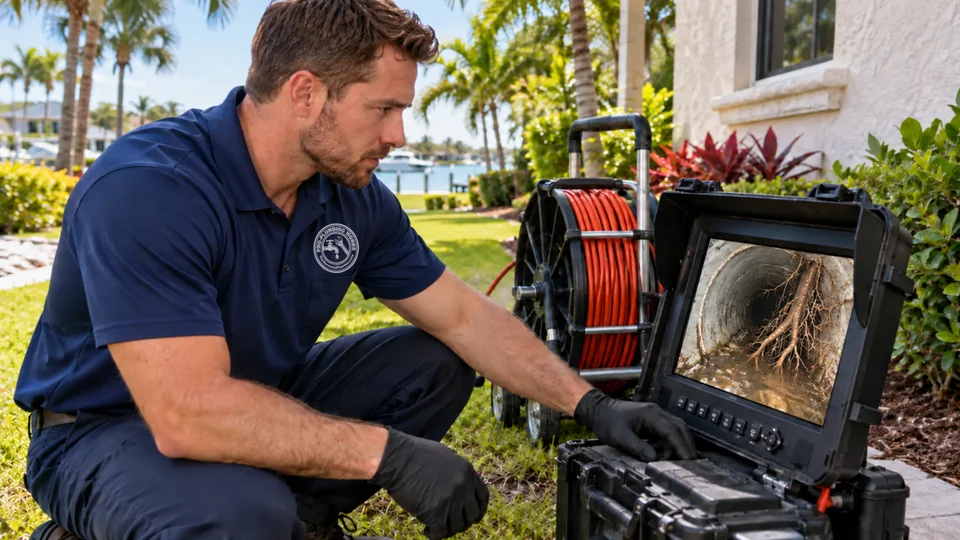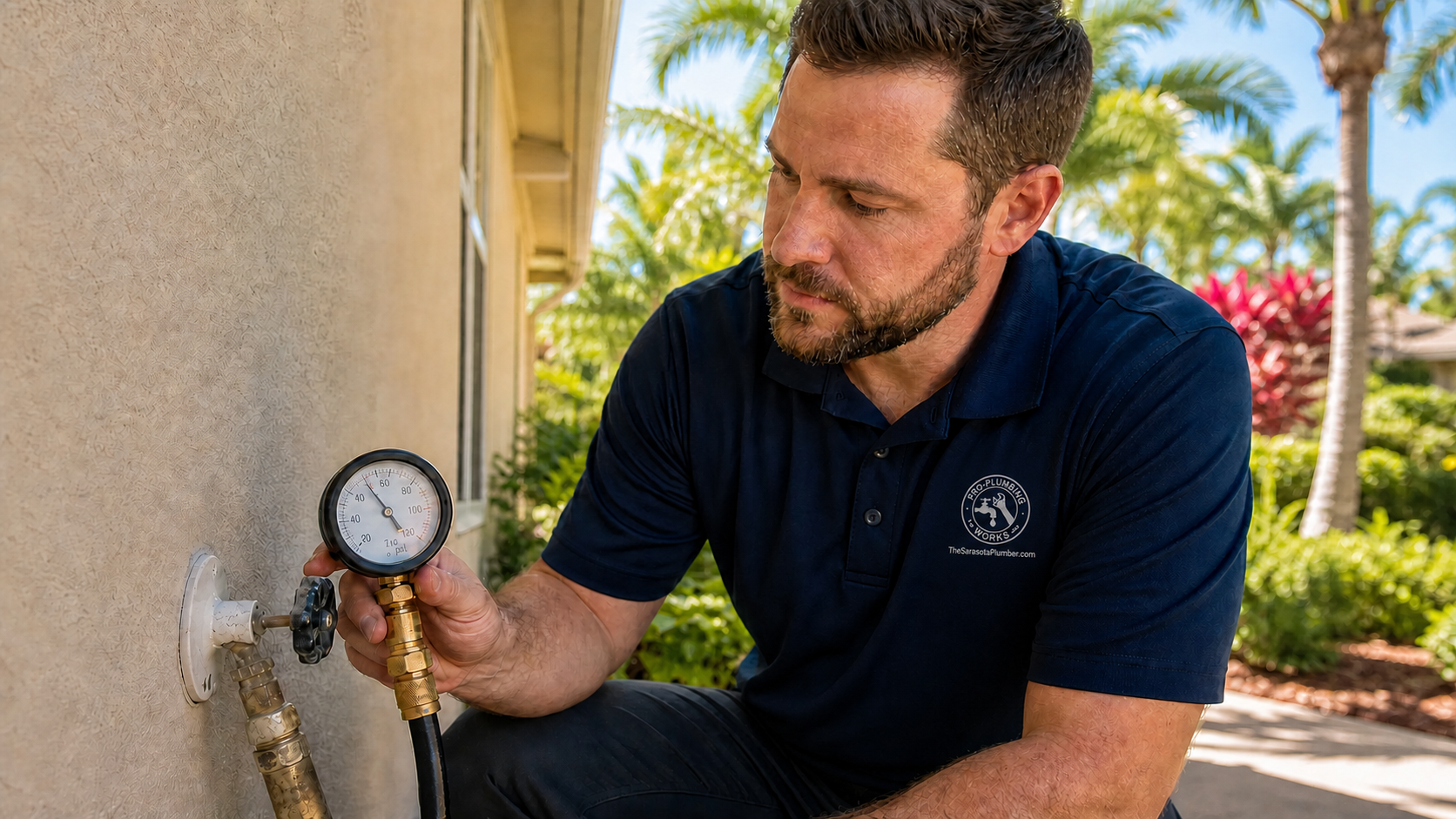
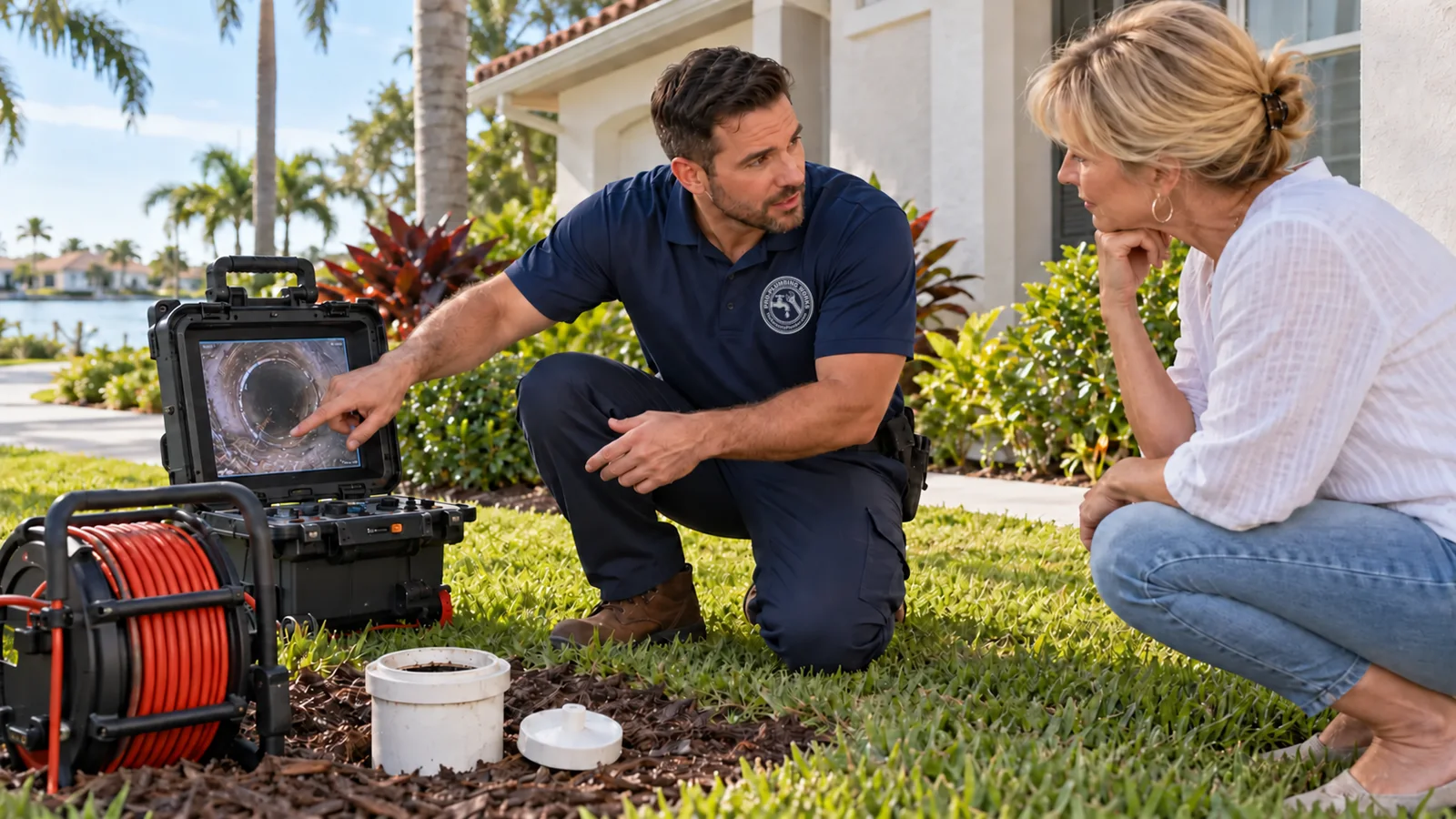
A sewer line does not need complete replacement simply because it clogged. Cleaning should restore access when possible, and camera inspection should identify the pipe material, defect, location and extent. A short damaged section may allow targeted repair. An inaccessible or poorly routed line may be a candidate for rerouting. Widespread structural failure may justify replacement.
The repair scope should follow the evidence, not the age of the home alone.
What symptoms justify a sewer-line evaluation?
Watch for repeated main-line backups, several slow fixtures, gurgling, sewage at a low drain, damp or sunken ground, recurring roots or a stoppage that returns shortly after cleaning.
If neighbors are affected or wastewater appears at a public cleanout, utility involvement may be possible. Use our guide to who to call for a Sarasota sewer backup before assuming every blockage is private.
Why might a sewer line need cleaning before a camera inspection?
A camera needs room and visibility. Standing wastewater, heavy scale and a dense blockage can hide the wall or prevent travel. Cleaning may be required first, but the method must match the pipe's condition.
After flow is restored, the inspection can document cracks, offsets, bellies, root entry, corrosion, missing sections or previous repairs. A camera image should be paired with location information and symptom history.
What is a targeted sewer repair?
Targeted repair removes and replaces a defined defective section. It can be appropriate for a localized break, failed joint or damaged connection when the rest of the line appears serviceable.
The practical scope depends on depth, access, nearby utilities, slab or landscape impacts and whether adjacent pipe can make reliable connections.
When does rerouting make sense?
Rerouting creates a new path around a damaged section that's difficult to access or has experienced repeated problems. It may reduce disturbance to a finished area, but the new route still needs proper slope, venting, cleanouts, connections and permits.
Rerouting is not automatically easier or cheaper. The plumber must evaluate elevations, fixture layout, structural elements and the connection point.
When is replacement justified?
Replacement may be appropriate when failure is extensive, multiple sections are compromised, the line has collapsed, reliable connections cannot be made or repeated repairs would leave an unreliable system.
Older cast iron should be evaluated by condition. Pro-Plumbing Works does not assume every older line needs replacement. Our Sarasota cast-iron drain guide explains when milling may help a suitable pipe and when structural damage changes the recommendation.
What about trenchless pipe lining?
Pro-Plumbing Works does not offer or recommend pipe lining. Its service approach focuses on diagnosis, drain pipe milling for suitable cast iron, targeted repair, rerouting and replacement when the pipe is structurally compromised.
Homeowners comparing proposals should ask exactly what defect each method addresses and which company will be responsible for permits, access and restoration.
Does sewer repair require a permit in Sarasota?
Plumbing-system alteration and sewer or waterline replacement commonly require permits. The City of Sarasota and Sarasota County operate separate permitting systems, so the correct authority depends on the address and scope.
Do not rely on a generic statement that a permit is never needed. The contractor should identify the jurisdiction, applicable inspection and any utility coordination before work begins.
What affects cost and disruption?
Important factors include:
- defect location and depth;
- pipe material and diameter;
- access beneath slabs, driveways or landscaping;
- nearby utilities and tree roots;
- dewatering or soil conditions;
- permit and inspection requirements;
- connection and cleanout work;
- surface restoration;
- whether occupants can use plumbing during work.
A written estimate should describe the included repair and major exclusions rather than relying on a vague per-foot number.
What should be documented before work?
Ask for the camera findings, marked location, recommended scope, permit responsibility, access plan, restoration limits, warranty terms and what would trigger a change order. Keep before-and-after video or photographs when available.
How do interior and exterior repairs differ?
An exterior repair may affect landscaping, irrigation, driveways or utility crossings. An interior repair may involve slab cutting, dust control, flooring, cabinets or temporary room closure. Neither is automatically simpler. The best route depends on the pipe elevation, defect and reliable connection points.
For occupied homes, ask which fixtures will be unavailable and for how long. Wastewater should not be used while an open drain is under repair.
What does a post-repair check include?
The contractor should verify connections, slope or flow, cleanout access and required inspections before closing the work area. Camera documentation can be useful where the repaired section is accessible from the line, but passing a camera is not a substitute for required permit inspection.
Surface restoration should be defined separately. Plumbing work may not include matching tile, flooring, concrete finish, landscaping or irrigation.
How should homeowners compare proposals?
Compare the diagnosed defect and repair boundary before comparing price. One proposal may cover a short spot repair while another includes a longer route, permit, cleanouts and restoration.
Ask each contractor:
- What evidence supports this scope?
- Which pipe remains in service?
- Who obtains permits and inspections?
- What surfaces are removed and restored?
- What conditions could change the price?
- What warranty applies to labor and material?
The clearest proposal is the one that connects the work to the documented condition.
What should happen before excavation or slab cutting?
The route and repair area should be marked as accurately as practical. Before outdoor excavation, the contractor should contact Sunshine 811 to have participating utilities locate their underground lines. Private lines may require separate locating. Public utility locating does not necessarily identify every private water, sewer, irrigation, gas or electrical line, so the contractor and owner should discuss known private utilities. Interior work also needs a dust, debris and access plan.
Photograph existing landscaping and finishes. Move fragile belongings, provide clear access and confirm where excavated material or equipment will go. In a condominium or managed community, review association notice, work-hour and common-area protection rules.
Can homeowners keep using part of the plumbing?
Only if the contractor confirms which fixtures remain safely connected. Water entering an open or disconnected drain can flood the work area with wastewater. Plan bathroom and kitchen use before the line is opened, especially when the repair extends beyond one day or requires inspection before backfill.
Why is the lowest bid not always comparable?
A low number may omit permits, locating, concrete, flooring, landscaping, cleanouts, hauling or post-repair testing. It may also assume that every exposed section is reusable. A responsible proposal states its assumptions and explains how concealed conditions will be handled.
Pro-Plumbing Works provides sewer-line repair, drain pipe milling and camera inspection throughout Sarasota and Manatee Counties. Call 941-894-1127 or request service online.
Frequently asked questions
Does every sewer backup require repair?
No. A removable blockage can occur in a structurally serviceable line. Repeated blockages or documented defects make repair more likely.
Can one broken section be repaired?
Often, if the defect is localized and sound pipe is available for reliable connections on both sides.
Is rerouting always less disruptive?
No. Elevation, access, structural work, finishes and the new connection path determine disruption.
Can drain cleaning fix a collapsed pipe?
No. Cleaning removes obstructions but cannot restore missing structural support or reconnect separated pipe.
Should I get the camera recording?
Yes, when available. Ask the plumber to explain the location, material and defect shown rather than relying on video alone.